

A Little Fancy
By the time Megan Baylous, founder of macaron empire Lady Yum, sits down for an interview with me at the Club, she has already stocked shelves at the Kirkland shop, covered for a delivery driver who called in sick and made a delivery herself. Such is the glamour of small-business ownership.
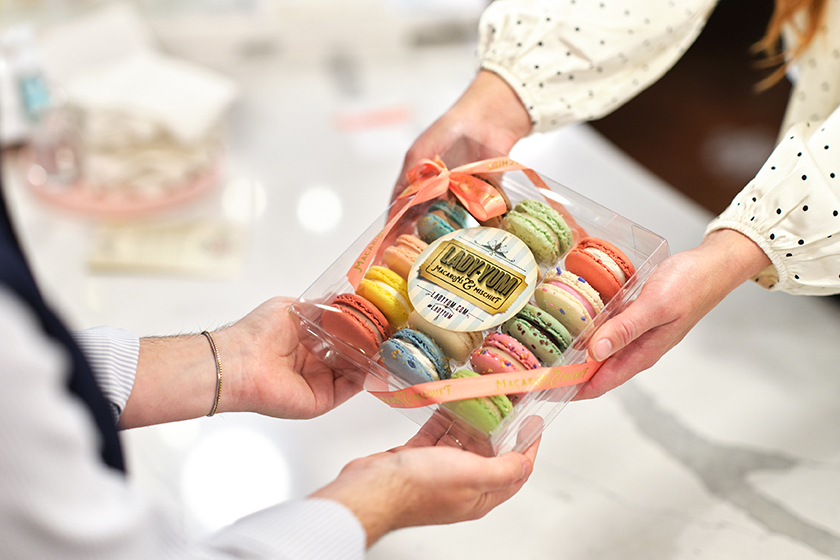
Somewhere in the middle of all that busyness, a couple came into her Kirkland shop and ordered the $7 special, a macaron and a glass of Champagne. They sat down. They stayed a while. The husband recognized Megan and told her how much he loved what she had built. They could stop in, have something fun and feel like they had gone somewhere, without committing to an expensive meal or waiting for an occasion.
Megan has heard plenty of compliments about the macarons, but this one landed differently. That customer had described her business almost exactly as she’d imagined it: a place where people could break up an ordinary day with something beautiful, delicious and just fancy enough to feel like an event.
Sometimes a macaron isn’t only a macaron. And sometimes, Megan acknowledges, “you have to look for the delight.” As a mom and macaron mogul, she gets caught in the same mental loops the rest of us do—work, stress, the list that doesn’t get shorter. But what she has discovered is that something novel, funny or faintly absurd can be just enough to break that loop. The older she gets, the more convinced she becomes that pleasure needn’t be earned through productivity, justified by a special occasion or saved for the end of something. A little break in the middle of the day is exactly the point. “A little fancy is kind of important,” she says. And it’s not hard to agree with her.
That instinct predates Lady Yum by decades. A hostess at heart, Megan grew up in a small logging community in Alaska and started working in restaurants around age 12. She discovered she had a knack for making people feel welcome—and appreciated that same warmth when she was a guest. She still remembers restaurants where the food was unremarkable but the restaurant staff made her glad she’d come. The feeling of being cared for stayed with her long after the meal was over.
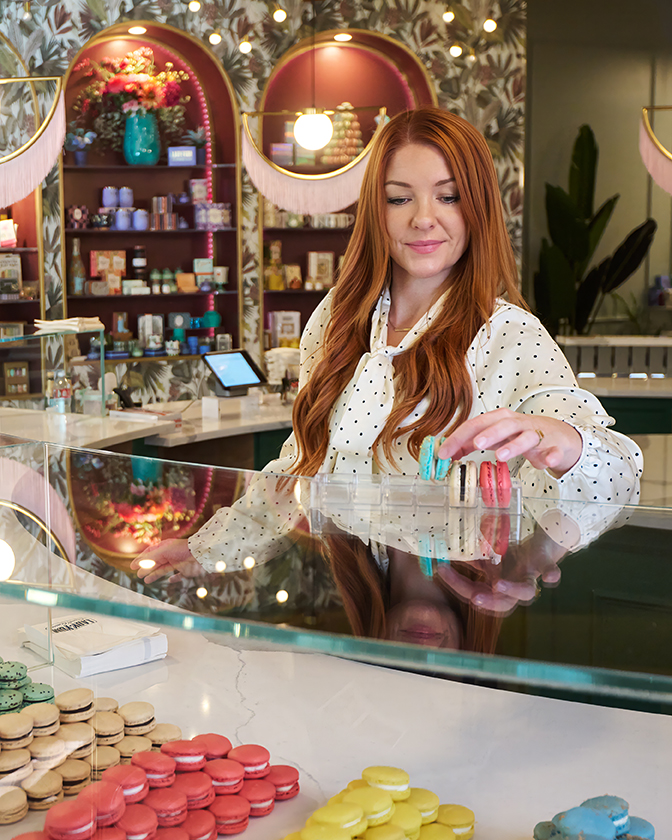
After college Megan went into finance, and by the time she was commuting an hour each way and raising a young daughter, the life she had built did not much resemble the life she had envisioned for herself. Growing up in a village of roughly 800 people had given her a different model, one where people looked after one another whether or not they liked each other. When she finally left the corporate world for the baking business she had been imagining for years, part of what she meant to build was the community she was missing.
The business took a while to find its shape. She made custom cakes, worked weddings and accepted any baking gig that came along, giving herself three years to decide whether it could support her and her daughter. One summer of roughly 60 weddings settled the cake question. Cakes were labor-intensive, hard to hand off and required her to work weekends, precisely when she wanted to be home.
Meanwhile, customers kept asking for French macarons—something Megan had never eaten, let alone made. Eventually, she found a recipe and tried it, expecting something like a crunchy meringue, only to discover the delicate, chewy cookie she would eventually build a business around. In 2014 she opened the first Lady Yum in a 700-square-foot former frozen yogurt shop in Kirkland.
In hindsight, the macaron is well suited to what Megan was after. The French cookie is colorful and playful and carries that fancy sense of occasion without requiring much commitment. There is suspense in choosing one, wondering whether the green one is pistachio or mint, or realizing that the blue one is coconut. And there is a little bit of merriment that comes from eating something so pretty on an otherwise forgettable afternoon. It’s an accessible extravagance, which is perhaps why Megan’s comment about the importance of “a little fancy” feels like a philosophy worth living by.
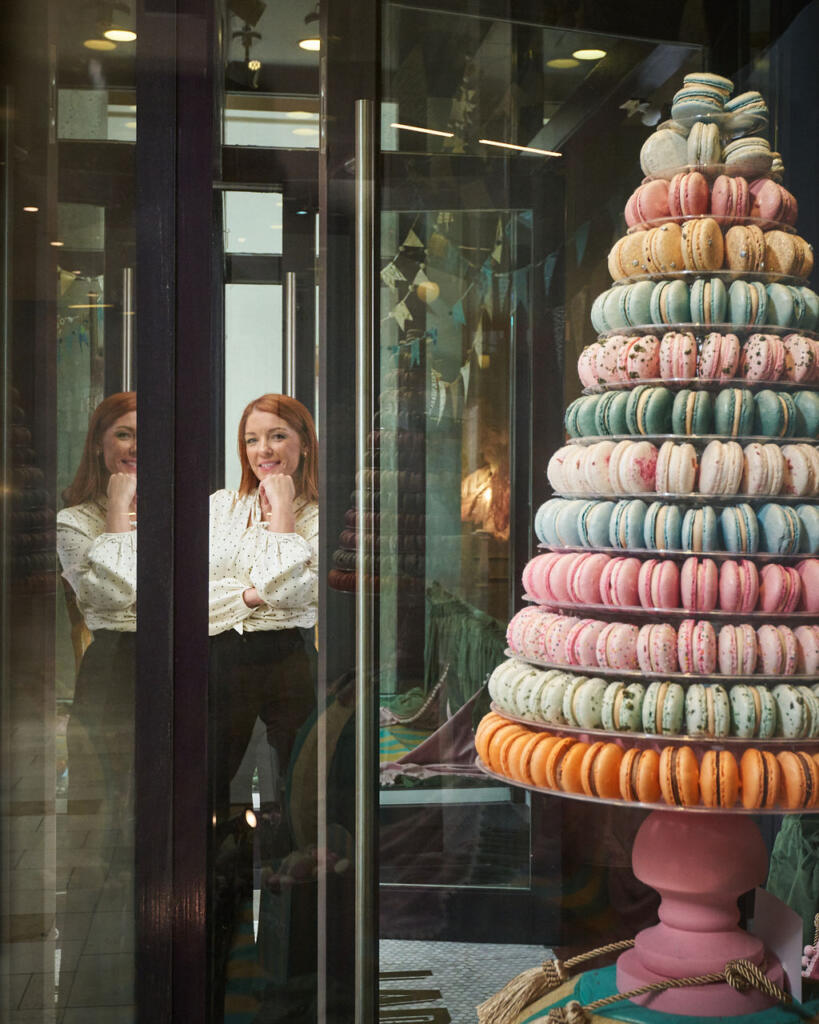
That philosophy includes a healthy dose of lighthearted folly in the form of “twirl awards,” where customers ascend a little pedestal and announce something they were proud of, no matter how small a win. Stores held a 5 p.m. toast with champagne, water or an imaginary glass simply to acknowledge that another day had happened. There is value in the temporary escape of doing something silly.
Laughter, novelty and a little absurdity feel like fuel.
The stores themselves were designed around a similar idea. Megan intentionally made them different from one another, wanting each to belong to its own neighborhood while still feeling unmistakably like Lady Yum. The smaller locations, Kirkland and South Lake Union, are intimate, like little clubhouses. Pioneer Square, her passion project, is larger and more theatrical, with touches of fur, feathers, velvet and animal print. That location also made the connection between delight and belonging even clearer. Megan has always loved Pioneer Square for its history, character and grit, and after opening there she got to know some of the people living on the streets around the store. People who looked intimidating from a distance became familiar faces with names and backstories. They watched the block because it was theirs, and the experience reinforced something Megan had understood since Alaska: People want to be acknowledged and to feel that they belong somewhere.
Over the past few years, Megan has felt more disconnected from that feeling. COVID-19 arrived on the heels of rapid expansion. A strong 2022 gave way to a harder economy for food businesses, while at the same time she was working through a lengthy divorce. She credits her longtime leadership team with keeping Lady Yum moving while much of her attention was elsewhere, but she can see now how far she had drifted from what made her want to start the business in the first place. With some mental space finally opening up, Megan has arrived at a realization that was both obvious and easy to miss: “I need exactly what I built for other people right now.”
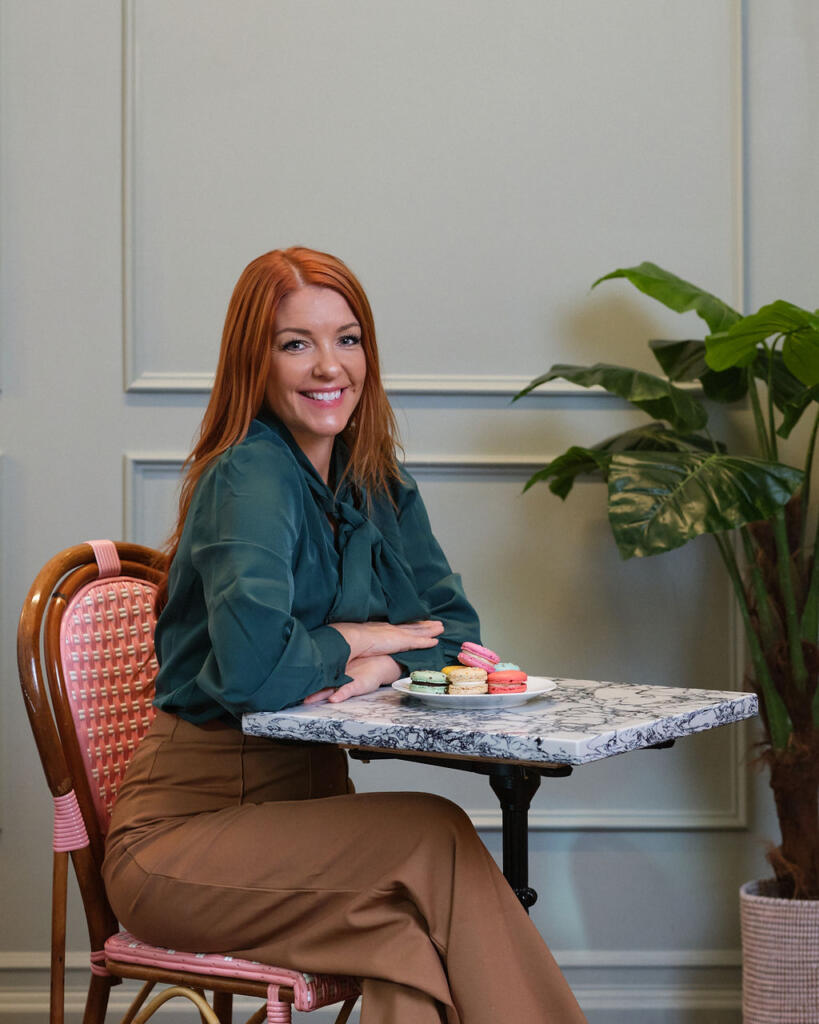
Megan and her leadership team have taken to calling this next chapter “rediscovering the whimsy,” or, less reverently, “turning Lady Glum back into Lady Yum.” To that end, Megan is spending more time in the shops, talking to customers and thinking about how to teach a new generation of employees that hospitality is more than getting an order right. She wants people to feel noticed. She wants someone walking in alone to feel comfortable being there. She wants the shops to be somewhere you can enter without an invitation and still find a place waiting.
Megan is not pretending that a hard stretch dissolves simply because somebody hands you a glass of champagne. And asked whether she feels fully back, she admits no, not yet.
But she has come around to the view that real problems and real joy can coexist in the same life, and that most of us could stand to be more deliberate about the second one. Delight, as Megan describes it, isn’t denial. It’s noticing the good thing that is happening alongside everything else: five minutes with a friend, a laugh with a stranger, someone holding the door, a reason to dress up or a glass raised to nothing in particular.